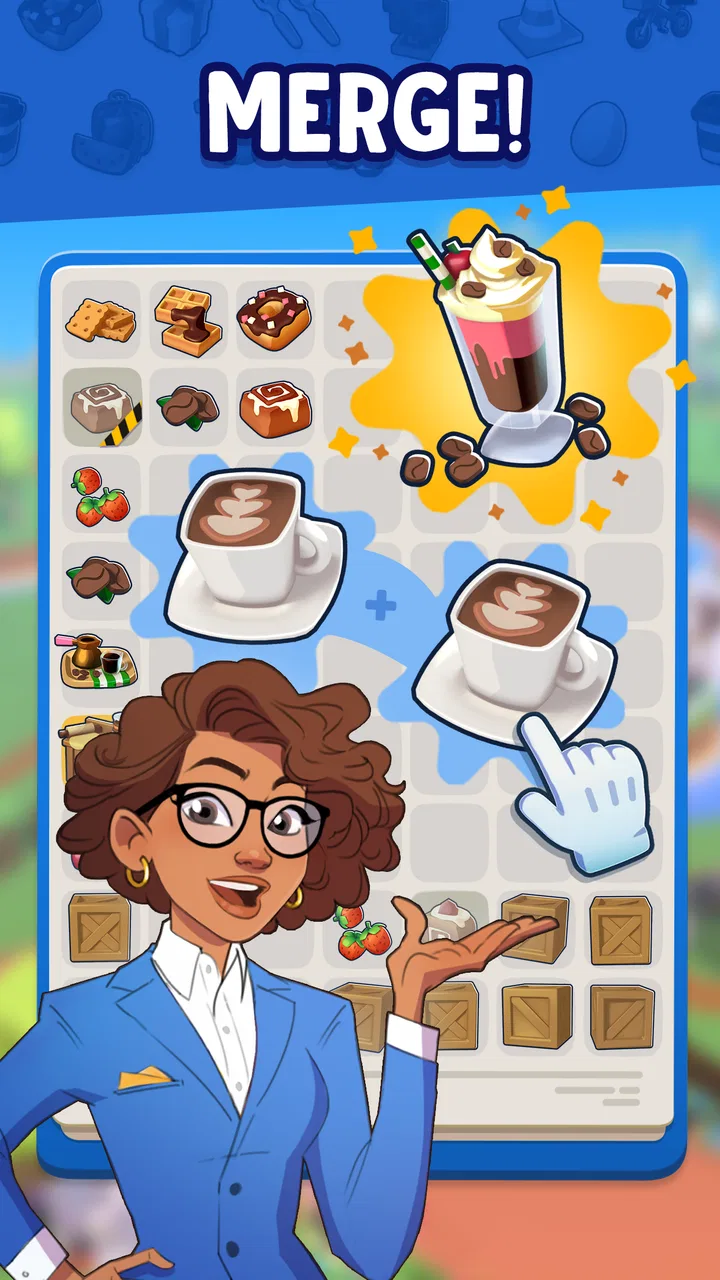
Merge Mayor - Match Puzzle
- 4.6
- Rating
- 1.00M
- Installs
- Free
- Price

 Analysis by App-foxy
I spent time with Merge Mayor - Match Puzzle as a relaxed city-building puzzle rather than treating it like a quick matching game. Its basic idea is easy to understand: combine matching items, use the results to support a growing town, and keep deciding what deserves your limited attention next. That simple loop is the reason it feels approachable, but the longer I played, the more I noticed that good progress depends on timing, board space, and resisting the urge to merge everything immediately.
Developed by StarBerry Games, this free puzzle game is aimed at an Everyone audience and runs on devices using Android 7.1 or later. It has built a sizeable audience, with more than a million installs and a 4.6 average from roughly 77 thousand ratings. Those figures make sense to me: the presentation is friendly, the early tasks are clear, and the game gives casual players plenty of small decisions without demanding expert puzzle knowledge from the first minute.
The important thing is to approach it with the right expectations. This is not a traditional match-three game where every move is about clearing a board in a few seconds. It is closer to a merge-and-management routine, with the town giving the individual combinations a wider purpose. I found it most enjoyable in short sessions, especially when I wanted something that rewarded planning but did not require a completely uninterrupted evening.
You May Also Like

 Blood Strike: 2.5 Anniversary
Blood Strike’s Loadouts Turn Every Drop Into a Tactical Gamble
A close look at Blood Strike’s custom loadouts: how fast access to signature weapons reshapes its battle royale rhythm, rewards preparation, and narrows the gap between fights.

 Pandora - Music & Podcasts
Pandora’s Music Is Easy to Start, but Harder to Recover
Pandora’s strength is its low-effort path from a seed to a station. Its weak spot is how much confidence it asks you to place in connection, setup, and quiet recovery.

 8 Ball Pool
 Is Built on Rivalries, Rematches, and Routine
A close look at the rivalries, rematches, shared routines, and unanswered safety questions that turn a quick pool match into a persistent mobile community.

 Samsung Music
’s Quiet Strength Is Playing What You Already Own
Its reach comes less from spectacle than from dependable access to a personal library. That simplicity is both the app’s strongest retention engine and its ceiling.

 AccuWeather: Weather Radar
AccuWeather Review: A Quick, Clear Forecast for Everyday Decisions
For everyday plans, the best forecast is the one you can understand quickly. AccuWeather makes rain timing, radar, and local conditions easy to act on, with a few trade-offs.

 Hill Climb Racing
Why Hill Climb Racing Still Turns Crashes Into One More Run
A tiny car, a bumpy hill and one more upgrade: Hill Climb Racing keeps resurfacing because its simple chaos makes every near-miss feel personal.
More From Our News Desk



How the everyday merge routine actually feels
The normal workflow is straightforward. I look at the available objects, find compatible pieces, combine them, and use the resulting items to move the current town activity forward. The satisfaction comes from seeing small combinations turn into more useful objects, then watching those objects contribute to a broader sense of development. It is a gentle progression loop, but it works because each action usually has a visible consequence.
At the beginning of a session, I recommend scanning the whole play area before tapping anything. New players often merge the first obvious pair and only then notice that they have separated pieces that would have created a better chain. A quick look helps me identify which objects are already close to a useful combination and which spaces should remain open for incoming items. This habit sounds minor, yet it prevents the board from becoming cluttered too quickly.
A realistic use case is a short break during a commute or while waiting for an appointment. I can open the game, complete a few combinations, check what the town is asking for, and stop without losing the thread. The interface is easy enough to re-enter after a pause because the central activity remains familiar: inspect, merge, and choose the next useful destination for the result.
That accessibility is also why the game works well for players who enjoy light strategy but do not want complicated controls. The challenge comes from choosing an order, not from memorizing a large control scheme. I never felt that I needed fast fingers. I did feel that careless taps could leave me with an awkward collection of pieces, so the game rewards attention more than speed.
The town layer gives the puzzle activity a reason to continue. Without it, merging could feel like an endless sorting exercise. Here, the results connect to a larger goal of building a thriving city, which makes even modest progress feel purposeful. I liked having a reason to care about the next combination instead of simply chasing a high score.
At the same time, the city-building element should not be mistaken for a deep simulation. I would not choose this game if I wanted detailed zoning, complex budgets, or the freedom to design every part of a settlement. Its town development is there to frame the merge loop and provide direction. Players looking for a calm progression game will probably appreciate that focus; players seeking a full city-management sandbox may find it limited.
What I check before making the first merge
My most useful routine is to separate immediate needs from attractive distractions. If the current objective clearly depends on one type of item, I prioritize the chain that moves toward it. I do not automatically merge every pair just because it is available. Some combinations may be more valuable as part of a later sequence, while a premature merge can remove the flexibility needed to respond to the next request.
I also leave breathing room on the board whenever possible. A crowded area makes every later decision harder because I spend more time rearranging pieces and less time thinking about their purpose. When I have several possible merges, I usually choose the one that both advances the current goal and reduces clutter. That double benefit is more useful than choosing a combination only because it produces the most visually impressive result.
Another practical habit is to pause after completing a task rather than immediately spending every new item. The board can change the way I approach the next objective, and a few seconds of observation often reveal a better sequence. This is especially helpful for players who tend to play by impulse. Merge Mayor is forgiving in its presentation, but it still rewards a deliberate rhythm.
Settings and controls worth checking
I would begin by checking the available sound and notification controls on the device and inside the game, where applicable. A puzzle built around short sessions is much easier to live with when its audio fits the situation. I prefer quieter settings when playing in public, while a little sound can make the combinations feel more satisfying at home. The key point is to make the game fit your routine instead of letting it interrupt you.
I also suggest reviewing the device’s display and battery behavior if you plan to play for longer stretches. The game is visually simple enough for casual use, but any title built around repeated tapping can encourage longer sessions than intended. Keeping the screen comfortable and avoiding unnecessary background activity makes a difference, particularly on older phones that still meet the minimum Android requirement.
Because the game is free to download but includes optional purchases ranging from $0.99 to $244.99 per item, I would check purchase protections before handing the device to a child or another family member. The Everyone age rating makes it approachable for a broad audience, but an age rating is not the same thing as a spending plan. I consider this one of the most important practical steps before letting younger players use it independently.
I would also make sure the game is updated through the normal platform tools and check that the phone has enough free space for ordinary app maintenance. The current version is 5.10.804, and keeping software current is generally sensible for compatibility. I do not treat an update number as a reason to change the way I play, but I do prefer starting a session with the game in a stable state.
One setting-related choice is not really a menu option at all: I decide when I will play. If I open a merge game while trying to work, I am more likely to keep returning for “one more” combination. If I reserve it for a break, the same loop becomes a pleasant reset. That boundary matters more here than searching for a perfect configuration.
Faster patterns that do not sacrifice control
The fastest approach I found is not rapid tapping. It is reducing wasted movement. I group related items mentally before acting, then complete the shortest useful chain first. This keeps the board readable and makes it easier to see what has changed after each merge. Speed comes from making fewer unnecessary decisions, not from pressing buttons as quickly as possible.
I use a simple priority order. First, I look for a combination that directly supports the active town request. Next, I consider a merge that clears a troublesome part of the board. Only after those options do I spend time on combinations that are mainly for general progression. This order prevents me from filling the board with attractive but currently irrelevant results.
There is also a useful distinction between creating a higher-level item and creating space. A larger item may look like the obvious reward, but if the board is becoming crowded, a smaller practical merge can be better because it opens room for the next useful piece. Experienced play is often about accepting a slightly less exciting move that keeps future options alive.
I try not to interrupt a promising chain halfway through unless the current objective demands it. When several matching pieces are close to forming a stronger result, keeping them together makes the next session easier to plan. This is one of the few habits that feels genuinely advanced without requiring any undocumented trick: preserve a clear path instead of scattering pieces across the board.
For short sessions, I set myself one modest goal, such as advancing a town request or cleaning up a congested area. That keeps the game from turning into aimless tapping. For longer sessions, I alternate between progress and organization. I make a few purposeful merges, then use the resulting space to prepare the next sequence. This rhythm feels more reliable than trying to push the city forward continuously.
The game also benefits from a “stop before frustration” rule. If I reach a point where the board is messy and I am making moves without understanding why, I pause. Returning later with a fresh view is often more productive than forcing a poor sequence. Since the game is free and designed for casual accessibility, there is no reason to turn its relaxing loop into a stressful obligation.
Where the strategy becomes less flexible
The main limitation is that the merge loop can become repetitive if you need constant novelty. The pleasure comes from gradual improvement and organization, not from dramatic changes in the rules. I enjoyed the steady pace, but I can imagine players who prefer frequent new mechanics or intense time pressure losing interest sooner.
Board management can also feel like friction rather than strategy when too many pieces compete for attention. The same space constraint that creates meaningful choices can become tiring if I am repeatedly moving items simply to make room. This is why I consider organization a core skill rather than an optional cleanup step. If you dislike sorting and planning, the game may feel more fiddly than fun.
The free-to-play structure deserves a careful look as well. Optional purchases can make the experience more convenient, but I would not recommend buying simply because a session feels slow. The best way to judge the game is to play its ordinary loop first and decide whether the pace suits you. If the only enjoyable version seems to require spending, that is a sign the game may not be the right fit for your preferences.
Players should also know what kind of comparison is fair. Against a traditional match-three title, this game offers more persistence and a stronger sense of building toward something, but less emphasis on quick board-clearing excitement. Against a dedicated city builder, it is far easier to pick up and much lighter on management, but it does not offer the same depth of planning or customization. Compared with a pure idle game, it asks me to make more active choices instead of simply checking progress.
That middle position is its strength and its boundary. I would recommend it to someone who wants a puzzle they can revisit, with enough planning to make choices matter and enough structure to avoid feeling lost. I would steer a competitive puzzle fan toward a game with tighter move limits or score chasing, and I would point a serious city-builder player toward a more detailed simulation.
The Android requirement of 7.1 or later keeps it available to many older devices, which is useful for people who do not replace phones frequently. Still, performance and comfort depend on the individual handset, so I would avoid judging the experience solely by the operating-system requirement. On a small or aging screen, repeated board management may feel less comfortable than it does on a newer display.
Who will get the most from it
I think the best audience is someone who enjoys visible progress in small steps. You might like arranging objects, planning a few moves ahead, and watching a settlement develop without having to manage a complicated economy. It is also a good choice for players who want something they can play in brief bursts rather than commit to a long campaign every time they open it.
Families may appreciate the approachable puzzle format and Everyone rating, but I would still supervise purchase settings and explain that optional items can cost real money. For an adult who wants a quiet evening game, the gentle pace is a plus. For a child who expects constant action, the deliberate rhythm may feel too slow unless they already enjoy sorting and gradual construction.
I would skip it if your ideal puzzle game is built around perfect solutions, rapid reactions, or a finite set of handcrafted levels. The open-ended merge routine is more about managing choices over time than solving one sharply defined challenge. I would also skip it if you dislike free games with optional purchases on principle, even when you can approach them without spending.
One of the more useful ways to play is to treat the town requests as a planning checklist rather than a command to act immediately. I read the request, inspect what is already available, and decide whether a short preparation phase will make the next few moves cleaner. This turns the game from a sequence of taps into a repeatable workflow: assess, prepare, merge, deliver, and reorganize.
That workflow is where I see the game’s strongest practical value. It gives casual players a small space to practice prioritization without making the lesson feel like work. I am constantly deciding whether to pursue the obvious reward, preserve a piece for later, or spend a move to improve the board’s layout. Those decisions are simple, but they are specific enough to keep the loop from becoming completely automatic.
After spending time with it, I see why the game has earned a 4.6 average and around 2.7 thousand written reviews. Its appeal is not based on one spectacular feature; it comes from a dependable combination of readable puzzles, town progression, and a pace that suits ordinary breaks. The developer, StarBerry Games, has positioned it as an accessible game rather than a demanding specialist experience, and that identity comes through clearly.
My verdict after settling into the routine
Merge Mayor - Match Puzzle is a good recommendation for anyone who wants a calm merge puzzle with a clear city-building purpose. I like that it gives each combination a reason to exist, and I appreciate that careful organization improves the experience more than frantic tapping. The strongest players will not necessarily be the fastest; they will be the ones who protect space, read the next objective, and avoid spending useful pieces without a plan.
My biggest reservation is the gradual repetition. The same relaxed structure that makes it easy to return can also make it feel predictable. The optional purchase range, from $0.99 to $244.99 per item, is another reason I would approach it with sensible spending limits. I would play it for the decisions and progression, not because I felt pressured to accelerate either one.
In the end, I would install it if I wanted a free puzzle game for short, thoughtful sessions and did not mind a slower form of progress. I would keep my settings comfortable, protect purchase controls, and use the scan-before-merge habit from the start. If that sounds appealing, this is a friendly and surprisingly strategic way to build a town one considered combination at a time.
FAQs for Merge Mayor - Match Puzzle
01What is Merge Mayor - Match Puzzle, and how is the gameplay structured?
Merge Mayor - Match Puzzle is a casual puzzle and town-building game in which you combine matching objects to create upgraded items. These items help complete orders, clear areas, and improve the town. The gameplay is easy to understand, but the limited board space and increasing upgrade requirements add strategy. It is designed for short sessions, although progression can encourage longer play.
02Is Merge Mayor - Match Puzzle free to download and play?
Yes, Merge Mayor - Match Puzzle can generally be downloaded and played for free on supported Android and iOS devices. However, the game may include optional in-app purchases for premium currency, energy, boosters, or other time-saving items. You can make progress without paying, but free players may need to wait for energy to refill or manage resources more carefully.
03Does Merge Mayor - Match Puzzle require an internet connection?
An internet connection may be needed for certain features, including loading events, synchronizing progress, displaying advertisements, processing purchases, and accessing online services. Some basic gameplay may work temporarily while offline, but this should not be assumed for every mode or device. Connecting to the internet is recommended when launching the game or restoring saved progress.
04Are advertisements and in-app purchases included in the game?
Merge Mayor - Match Puzzle may contain advertisements and optional in-app purchases. Ads can sometimes provide rewards such as extra energy, useful items, or bonuses, while purchases are intended to speed up progress or provide additional resources. The game can still be enjoyed without spending money, but players should review the purchase settings and use device-level parental controls when necessary.
05Is Merge Mayor - Match Puzzle suitable for children and casual players?
The game is suitable for casual players who enjoy simple matching mechanics, collection systems, and gradual town development. Its colorful presentation and straightforward controls make it accessible, but younger players may be tempted by timers, advertisements, or optional purchases. Parents should check the official age rating, privacy information, and payment settings before allowing children to play independently.
Pros
- Relaxing match-and-merge gameplay suited to short sessions.
- Town-building upgrades give progress beyond individual puzzles.
- Simple controls make it accessible for casual players.
- Frequent tasks and objectives provide clear goals to pursue.
- Bright visuals and friendly characters create a welcoming atmosphere.
Cons
- Energy limits can interrupt play during longer sessions.
- Some upgrades and progress may require considerable waiting.
- The board can become crowded as more items and chains unlock.
- Later puzzles may feel repetitive without major gameplay changes.
- Optional purchases can speed progress
- creating pressure to spend.

Merge Mayor - Match Puzzle
Gallery